From the Logic of the Site: How We Read a Plot of Land Before Designing
At MAAR, every project begins with a question that guides the whole process: what is this place telling us?
Before drawing the first line, we observe. We read the land as though it were a living map, full of information that — interpreted correctly — has the power to define an architecture that is more conscious, more functional and more connected to its setting.
Architecture is born of the site
Designing from the logic of the site means working with natural conditions rather than against them. A plot of land is never just a surface to build on. It is a composition of visible and invisible elements: solar orientation, prevailing winds, slope, views, vegetation, urban or natural context, noise, access points and topography. All of these shape the form a project will take.
When a design responds to its site, it is optimised on several levels at once: energy efficiency, thermal comfort, natural light and emotional connection with the surroundings.
Climate as protagonist
In regions such as the Mexican Caribbean especially, climate is not just another variable: it is the protagonist. High temperatures, humidity, tropical storms and extreme solar radiation demand deep analysis. That is why one of our first steps is to study how the site behaves climatically across the year.
That tells us, for instance, where to open a façade to catch the breeze and where to shield it from the sun. Choosing materials suited to the climate is also part of the conversation: stone, concrete, treated timber, latticework and ventilated volumes allow a more effective and more durable response.
Views are not imposed, they are discovered
At MAAR we believe every project has a privileged view, even when it is not obvious. Our job is to discover it, not to impose it. That might mean raising the shared living spaces to reach the horizon line, or orienting a bedroom towards a fragment of native vegetation that frames the experience of living there.
Understanding what cannot be seen
The subsoil, nearby infrastructure, local regulations and the conditions of the built environment are all part of the site too. Very often it is these invisible aspects that determine key decisions in an architectural proposal. That is why we collaborate from the outset with engineers, specialists and technical advisers who complete our understanding of the land.
Context as part of the design
Designing from the site also means acknowledging the social and cultural context. What kind of life happens around the plot? What architectural language predominates? How can we create a project that holds a conversation without either camouflaging itself or ignoring what surrounds it?
Our architecture seeks balance: to be part of a place while keeping an identity of its own. To respect without replicating. To respond without imposing.
Real cases: from analysis to form
In projects such as Casa AC, facing the mangrove in Puerto Cancún, the decision to raise the main areas to the second floor came after studying the natural view and the guidelines of the development. The main bedroom and the kitchen were therefore projected out over the landscape: mangrove, lagoon, beach and sea, with nothing in the way.
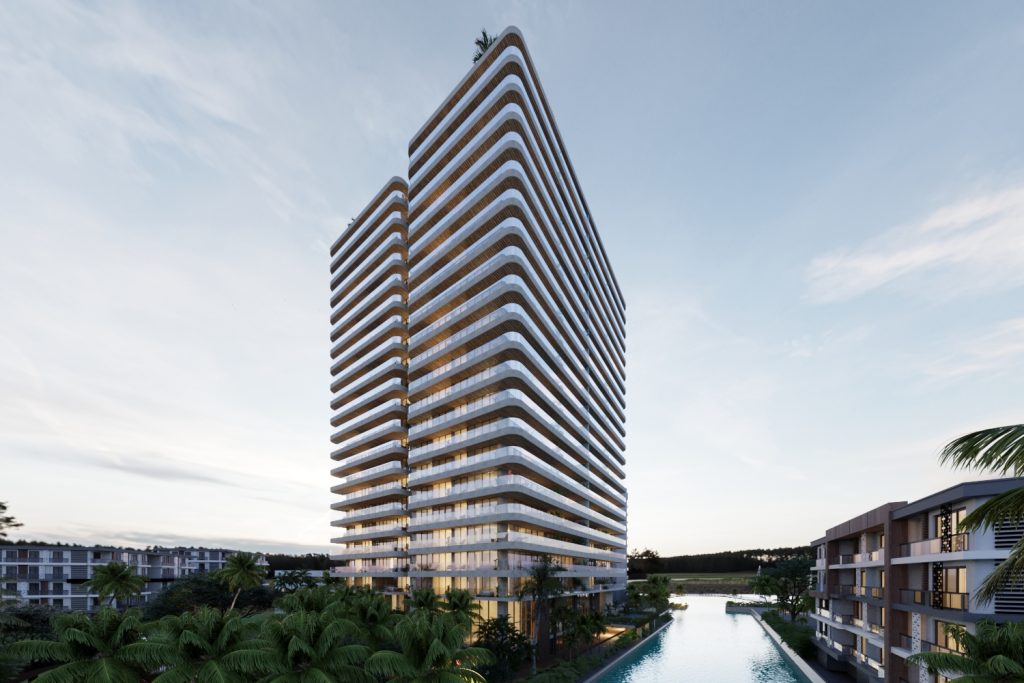
Another example is Thompson Private Residences, where the triangular form of the building is not an aesthetic gesture but the direct consequence of the plot’s irregular polygon and of the intention to open every unit to the best solar orientation and views.
Every decision has a reason that comes from the site.
Working from the logic of the site is not a trend: it is a design ethic. In a world where homogenisation threatens to erase the identity of places, returning to the local and the specific is a form of resistance.
Our projects could not exist anywhere else. Because they are not born of a formula but of an understanding of the land.
Many problems in architecture are solved before designing, if the right question is asked at the start. Understanding the site is the first step towards designing with intelligence and sensitivity.
About to start a project? The land may already hold the answer. Let’s talk.